H44T swing check valve
H44T swing check valve is a type of valve used to prevent med
2025-12-12 09:48:02


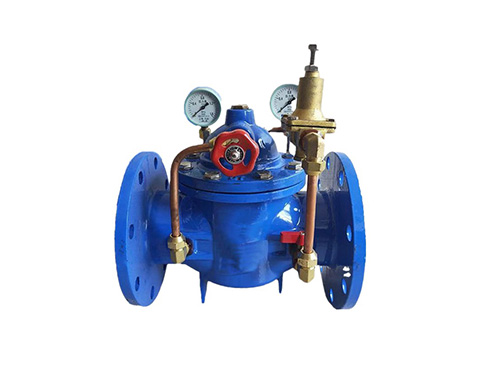
The 200X pilot operated pressure reducing valve is a specialized device that automatically reduces the working pressure of pipelines. It can reduce the high water pressure in the pipeline before the valve to the required level in the pipeline after the valve. Pressure reducing valves are widely used in high-rise buildings, areas with high water pressure in urban water supply networks, mines, and other occasions to protect each water point in the water supply system from obtaining appropriate service water pressure and flow. Given that the leakage rate and degree of water waste are almost directly proportional to the water pressure of the water supply system, pressure reducing valves have practical effects on the operating conditions of the main system and potential water-saving effects. According to statistics, their water-saving effect is about 30%.
When the output pressure or diameter of the 200X pilot operated pressure reducing valve is high, using a pressure regulating spring to directly regulate the pressure will inevitably result in excessive spring stiffness. When the flow rate changes, the output pressure fluctuates greatly, and the structural size of the valve will also increase. To overcome these drawbacks, a pilot operated pressure reducing valve can be used. The working principle of a pilot operated pressure reducing valve is basically the same as that of a direct acting valve. The pressure regulating gas used in pilot operated pressure reducing valves is supplied by small direct acting pressure reducing valves. If a small direct acting pressure reducing valve is installed inside the valve body, it is called an internal pilot operated pressure reducing valve; If a small direct acting pressure reducing valve is installed outside the main valve body, it is called an external pilot operated pressure reducing valve. Compared with the direct acting pressure reducing valve, this valve adds a nozzle baffle amplification element consisting of a nozzle, baffle, fixed orifice, and chamber B. When there is a slight change in the distance between the nozzle and the baffle, it will cause a significant change in the pressure in chamber B, resulting in a large displacement of the diaphragm 10 to control the up and down movement of the valve core 6, making the intake valve opening larger or smaller, and improving the sensitivity of the valve core control, that is, improving the stability accuracy.
Basic performance of 200X pilot operated pressure reducing valve
(1) Pressure regulation range: It refers to the adjustable range of the output pressure P2 of the pressure reducing valve, within which the specified accuracy is required. The range of pressure regulation is mainly related to the stiffness of the pressure regulating spring.
(2) Pressure characteristic: It refers to the characteristic of output pressure fluctuation caused by input pressure fluctuation when the flow rate g is constant. The smaller the output pressure fluctuation, the better the characteristics of the pressure reducing valve. The output pressure needs to be lower than the input pressure - a constant value in order to remain largely unchanged with changes in input pressure.
(3) Flow characteristics: It refers to the persistence of input pressure timing and output pressure changing with the variation of output flow g. When the flow rate g changes, the smaller the change in output pressure, the better. The lower the output pressure, the smaller the fluctuation with the change of output flow rate.
Selection of 200X Pilot operated Pressure Reducing Valve
Select the type and pressure regulation accuracy of the 200X pilot operated pressure reducing valve according to the usage requirements, and then choose its diameter based on the required large output flow rate. When determining the gas source pressure of the valve, it should be greater than the high output pressure by 0.1MPa. The pressure reducing valve is generally installed after the water separator and before the oil mist or setting device, and care should be taken not to connect its inlet and outlet in reverse; When the valve is not in use, the knob should be loosened to avoid frequent deformation of the diaphragm under pressure, which may affect its performance.
PRODUCT
Copyright © 2025-2026 http://www.xinhuifluid.com All Rights Reserved Hebei Xinhui Fluid Technology Co., Ltd.
Add:Wangtun Village, Siying Township, Botou City, Cangzhou City, Hebei Province
Url:http://www.xinhuifluid.com
Tel:+86-18230173208
Email:liu18230173208@gmail.com