H44T swing check valve
H44T swing check valve is a type of valve used to prevent med
2025-12-12 09:48:02


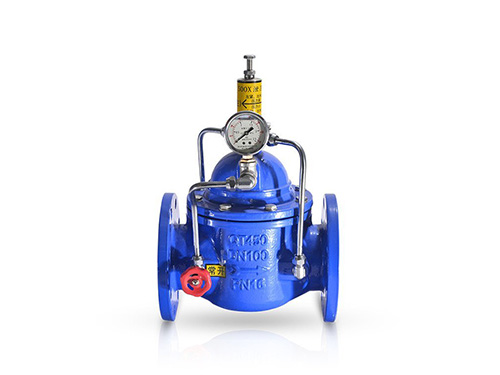
500X pressure relief holding valve. Used for water supply, air conditioning, and fire piping systems. The medium is water, with a temperature of ≤ 80 ℃. Used to stabilize the pressure of the pipeline in front of the valve. When the pressure in front of the valve exceeds the set value, the main valve opens for drainage. When the pipeline pressure drops below the set value, the main valve closes. The pressure value can be set by adjusting the screw through the pilot valve.
The 500X pressure relief and holding valve consists of a main valve, a pilot valve, a needle valve, a ball valve, and a pressure gauge.
Working principle: First, set the opening pressure of the main valve. Loosen the anti loosening nut of the pilot valve, turn the pilot valve screw clockwise, and the screw will move downwards. Adjust the spring to be compressed and apply a determined thrust to the guide valve core. At this point, the opening pressure of the main valve increases. Rotate the adjusting screw of the pilot valve counterclockwise, release the spring pressure, and reduce the thrust acting on the pilot valve core. At this time, the opening pressure of the main valve decreases. The pressure gauge can be used to observe the pressure value of the pipeline in front of the main valve. After setting, tighten the anti loosening nut.
When the pressure in front of the valve increases, the pressure in the lower chamber of the pilot valve diaphragm also increases accordingly. After exceeding the set value, the diaphragm drives the guide valve core to move upward, the guide valve opens, and the water in the upper chamber of the main valve diaphragm is discharged. The pressure drops, and the main valve core opens under the pressure difference between the upper and lower chambers of the diaphragm. The main valve begins to drain, and the pipeline pressure begins to decrease.
The pressure below the pilot valve diaphragm also decreases, and when the pressure drops below the set value. Under the action of adjusting the spring. The valve core is closed. The pressure in the upper chamber of the main valve diaphragm gradually increases, due to the fact that the area of the main valve diaphragm is larger than that of the main valve core, under the action of the pressure difference between the upper and lower chambers of the diaphragm. The main valve core is closed. The main valve stops draining.
Summary:
1、 When setting the opening pressure, the pressure in front of the valve should be gradually increased. Enable it at the set value. And record the pressure gauge value, then continue to increase the incoming pressure. Keep the main valve fully open for discharge (i.e. the discharge flow rate of the main valve no longer increases). Record the discharge pressure of the main valve. Then gradually reduce the incoming pressure until the main valve is closed, and record the valve's reseating pressure.
2、 Repeat adjusting twice or more until the main valve opens and the discharge pressure is reached. Until the recoil pressure stabilizes.
3、 When manual pressure relief is required. You can open the pressure relief ball valve on the main valve cover, and the pressure in the chamber on the main valve diaphragm will decrease. The main valve opens to release pressure, and the outlet of the pressure relief ball valve should be connected to the drainage ditch.
4、 When the opening pressure difference of the main valve is less than 0.5MPa, the deviation value is ± 0.02MPa. When P ≥ 0.5MPa, the deviation value is ± 0.04MPa.
5、 Discharge pressure ≤ 1.08P (P is the opening pressure value.)
PRODUCT
Copyright © 2025-2026 http://www.xinhuifluid.com All Rights Reserved Hebei Xinhui Fluid Technology Co., Ltd.
Add:Wangtun Village, Siying Township, Botou City, Cangzhou City, Hebei Province
Url:http://www.xinhuifluid.com
Tel:+86-18230173208
Email:liu18230173208@gmail.com