H44T swing check valve
H44T swing check valve is a type of valve used to prevent med
2025-12-12 09:48:02


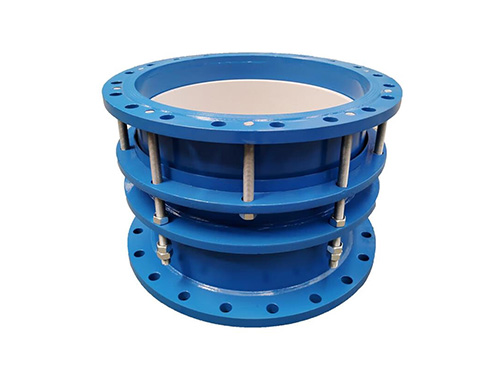
Double flange limit expansion joint (also known as flange expansion joint or limit expansion joint) is a rigid pipeline compensation component with flange connections at both ends. Its core function is to compensate for the axial displacement of the pipeline caused by thermal expansion, contraction, and installation deviation through the axial expansion and contraction of the body expansion section. At the same time, it uses a limit mechanism to limit the large expansion and contraction of the pipeline, prevent excessive stretching or compression of the pipeline, protect the pipeline interface and equipment, and is widely used in scenarios with rigid displacement compensation requirements such as water supply and drainage, heating, industrial pipelines, municipal pipelines, etc.
The core structure consists of an expansion tube, a body tube, flanges, limit rods, sealing devices, and guiding mechanisms. The expansion tube and the main body tube adopt a sliding fit, which can freely expand and contract along the axial direction; The flanges at both ends comply with the GB/T 9119 national standard and are compatible with pipeline flange connections, confirming the universality of installation; The limit rod is connected to the flanges at both ends by bolts, limiting the expansion and contraction (conventional axial displacement ± 10-50mm) to avoid damage caused by overtravel; The sealing device adopts rubber sealing rings or graphite fillers to achieve dynamic sealing and prevent medium leakage; The guiding mechanism protects the smooth movement of the telescopic tube and avoids offset and jamming. In terms of materials, the body and expansion tube are made of ductile iron, carbon steel or stainless steel, the limit rod is made of stainless steel, and the sealing element is made of nitrile rubber or EPDM, which is suitable for different working conditions.
The working principle is based on rigid expansion compensation design: during pipeline operation, temperature changes cause thermal expansion and contraction of the pipeline, and the expansion pipe expands and contracts axially relative to the body pipe, offsetting the displacement stress of the pipeline; During installation, the installation deviation of the pipeline can be compensated by telescopic adjustment, simplifying the alignment process; The limit rod is always in a tensioned state. When the displacement reaches the set value, the rod locks to prevent further expansion and contraction, avoiding interface detachment or equipment damage caused by excessive displacement of the pipeline. The sealing device always fits tightly during the expansion and contraction process, relying on the pressure of the medium to enhance the sealing effect and confirm that there is no leakage.
Key performance parameters adapted to rigid compensation requirements: nominal diameter coverage of DN50~DN1200mm, mainstream specifications of DN100~DN600mm; The nominal pressure is usually 1.0MPa, 1.6MPa, 2.5MPa, and the high-pressure version can reach 4.0MPa; Suitable for temperatures ranging from -20 ℃ to 350 ℃ (metal material), suitable for media such as water, steam, oil, and mildly corrosive fluids; The sealing level meets GB/T 13927-2008 level 1, with no leakage; Axial expansion and contraction range ± 10~50mm, limit accuracy ≤ ± 2mm; service life can reach 8~15 years under normal working conditions.
The core advantages of the product are outstanding: firstly, excellent rigidity compensation, suitable for high-pressure, high-temperature, and large-diameter pipelines, with good load-bearing capacity; The second is that the limit protection is in place, with excellent effect to prevent pipeline overtravel displacement and ensure the safety of the protection system; Thirdly, it is easy to install and can be adjusted on-site to compensate for installation deviations; Fourthly, the sealing performance is stable, and the dynamic sealing design adapts to frequent expansion and contraction, with low leakage risk; Fifth, it has strong weather resistance, metal structure aging and corrosion, and is suitable for harsh outdoor environments.
Typical application scenarios are extensive: in municipal heating pipelines, used to compensate for pipeline thermal expansion and contraction displacement; In industrial pipeline systems, it is suitable for steam pipelines and chemical medium pipelines, and can withstand high pressure and high temperature; In water supply and drainage engineering, it is installed at the outlet of the water pump and the long-distance laying section of the pipe network to adjust displacement stress; In high-rise buildings, it is used for displacement compensation of vertical pipelines to protect equipment inside pipeline shafts; In addition, it is also suitable for power plants, metallurgy, fire protection and other scenarios, complementing rubber soft joints to form a complete pipeline compensation system.
Attention should be paid to installation and maintenance: During installation, the flange bolts should be evenly tightened, and the sealing surface should be confirmed to be in contact; The limit rod should be adjusted for expansion and contraction according to the design requirements and should not be dismantled arbitrarily; When the medium is a high-temperature or corrosive fluid, corresponding high-temperature resistant (based on actual reports) and corrosion-resistant (based on actual reports) materials should be selected; Regularly check the wear of seals and the tightness of pull rods, replace aging seals in a timely manner, and tighten loose bolts; Long term disuse requires anti-corrosion treatment (based on actual reports) to avoid rusting of metal components.
PRODUCT
Copyright © 2025-2026 http://www.xinhuifluid.com All Rights Reserved Hebei Xinhui Fluid Technology Co., Ltd.
Add:Wangtun Village, Siying Township, Botou City, Cangzhou City, Hebei Province
Url:http://www.xinhuifluid.com
Tel:+86-18230173208
Email:liu18230173208@gmail.com