H44T swing check valve
H44T swing check valve is a type of valve used to prevent med
2025-12-12 09:48:02


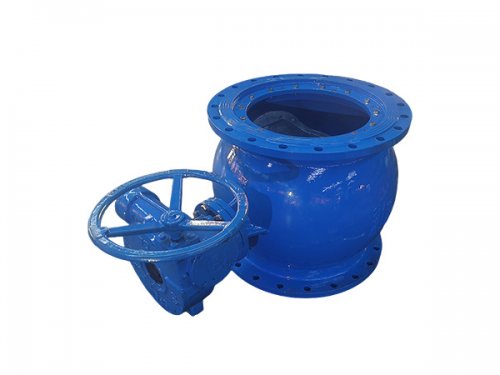
The turbine eccentric hemispherical valve is an effect control valve that integrates turbine transmission and eccentric hemispherical structure. Its core function is to drive the eccentric hemispherical valve core to rotate through the turbine reduction mechanism, achieving the cutoff, adjustment, and sealing of the medium. It is designed for complex media containing solid particles, high viscosity, easy crystallization, and easy scaling due to its frictionless opening and closing, wear-resistant (based on actual reports) anti blocking, and sealing compensation characteristics. It is widely used in industrial scenarios such as petrochemicals, metallurgy, power, and sewage treatment that require high valve performance.
1、 Core structure and material selection
1. Overall structural composition
The valve adopts an innovative design of "turbine drive+eccentric structure+ball front seal", and the core components include:
Valve body: adopts a straight through or side mounted structure, with no dead corners in the flow channel to avoid medium deposition; Some models have a top up design and can be repaired online without disassembling the pipeline.
Eccentric hemispherical valve core: the core control component, the sphere is only hemispherical and arranged eccentrically with the valve seat. When opened, the sphere speed is suitable to detach from the valve seat, and it only contacts the sealing surface at the moment of closure, greatly reducing friction loss.
Turbine transmission mechanism: composed of worm gear, worm gear, and handwheel, with accurate transmission ratio, easy operation, and low torque, capable of fine flow adjustment. Some large-diameter models are equipped with reduction gears to further reduce operating intensity.
Sealing compensation system: The rear end of the valve seat is equipped with a spring, which ensures sufficient pre tightening force on the sealing surface and can automatically compensate for wear; The sealing pair adopts PTFE+hard seal or metal hard seal combination, suitable for different working conditions.
Auxiliary components: including valve stem, shaft sleeve, packing seal, etc. The valve stem is made of stainless steel or 2Cr13 material, the shaft sleeve is made of wear-resistant (based on actual reports) alloy, and the packing is made of graphite or PTFE. It is confirmed that the shaft end seal is excellent.
2. Selection of key materials
The valve body material is mainly WCB cast steel and 304/316 stainless steel, suitable for conventional and corrosive working conditions; The valve core base material is welded with wear-resistant (based on actual reports) alloy, and the valve seat is welded with a special material to form a corrosion-resistant (based on actual reports) and wear-resistant (based on actual reports) sealing pair. PTFE, fluororubber, or metal hard seals are selected according to the working conditions. Metal seals are suitable for high temperature (≤ 350 ℃) and high pressure scenarios, while soft seals protect zero leakage under low pressure.
2、 Working principle (eccentric drive+frictionless seal)
The valve achieves detailed control through the synergistic effect of "turbine transmission eccentric rotation seal compensation":
Manually rotating the handwheel drives the worm gear transmission, driving the eccentric shaft to rotate 90 °, thereby driving the hemispherical valve core to move.
When opened, the eccentric structure allows the valve core to detach from the valve seat at a suitable speed, rotate uncontrollably to the fully open position, and the flow channel is fully connected, allowing the medium to pass smoothly. The eccentric design also forms a self-cleaning space, which is less likely to accumulate dirt.
When closed, the valve core only comes into contact with the valve seat in the later stage, and the hemispherical incision forms a shear effect with the valve seat, which can cut off debris such as branches and fibers in the medium and confirm smooth closure; At the same time, the spring pushes the valve seat to automatically compensate for the wear of the sealing surface, achieving excellent sealing that becomes tighter and tighter as it closes, and achieving zero leakage for non beneficial gas delivery.
3、 Key performance parameters
Nominal diameter: DN50~DN1400mm, mainstream specifications DN50~DN600mm;
Nominal pressure: PN16~PN64MPa, suitable for CLASS150~CLASS300 pressure levels;
Applicable temperature: -29 ℃~350 ℃, adjusted according to the sealing type and material;
Applicable media: complex media including solid particles, slurry, pulp, coal powder, sewage, oil and gas, corrosive solutions, etc;
Sealing grade: GB/T 13927-2008 Grade 1, metal sealing can achieve zero leakage;
Adjustment characteristics: approximate percentage of flow characteristics, adjustable range of 100:1, supporting detailed flow control;
Operating torque: ≤ 500N · m, with a large-diameter belt reduction mechanism that can be reduced to a range that can be operated by a single person.
4、 Core advantages
Wear resistant (based on actual reports) and anti blocking, suitable for harsh working conditions: the eccentric structure ensures that the valve core and valve seat open and close without friction, reducing wear; The shearing function can remove scaling obstacles, especially suitable for gas-solid and liquid-solid two-phase flow media, to avoid jamming phenomenon.
Excellent sealing and strong compensation: Spring type automatic compensation sealing design, the sealing surface can be automatically adjusted after wear, maintaining good sealing performance for a long time; The ball front sealing structure eliminates the erosion of the sealing surface by the medium, extending its service life.
Lightweight operation and meticulous adjustment: The turbo transmission mechanism reduces the opening and closing torque, making operation effortless and enabling fine adjustments; When fully open, the flow channel is unobstructed, the pressure loss is small, and the flow capacity is good.
Easy maintenance and long lifespan: The upper structure supports online maintenance, and replacing seals does not require disassembling the valve; The combination of wear-resistant (based on actual reports) and anti-corrosion (based on actual reports) materials and frictionless design can achieve a service life of 8-15 years, far superior to traditional ball valves and gate valves.
5、 Typical applications and installation maintenance
1. Application scenarios
Industrial industries: oil and gas transportation and chemical solution pipelines in the petrochemical industry, coal powder injection and slurry transportation in the metallurgical industry, hydraulic slag removal and heating pipelines in the power industry;
Environmental protection industry: sludge transportation in sewage treatment plants, pulp pipelines in pulp mills, suitable for media that are prone to sedimentation and crystallization;
Municipal Administration and Energy: High temperature fluid control for urban natural growth gas transmission pipelines, pressure stations, and heating systems.
2. Key points for installation and maintenance
During installation, it can be installed horizontally or vertically, and the operating and maintenance space should be protected. The valve arrow should be consistent with the flow direction of the medium;
Clean the pipeline impurities before installation, verify that the valve nameplate matches the operating conditions, and tighten the flange bolts evenly;
Check the lubrication condition of the turbine mechanism every 6 months and add lubricating grease; Check the wear of the sealing surface and the shaft end seal every year, and replace the packing or sealing components in a timely manner;
When stored for a long time, the valve core should be placed in the fully open position, the flanges at both ends should be closed, and the valve stem should be coated with rust inhibitor to avoid rusting and sticking.
PRODUCT
Copyright © 2025-2026 http://www.xinhuifluid.com All Rights Reserved Hebei Xinhui Fluid Technology Co., Ltd.
Add:Wangtun Village, Siying Township, Botou City, Cangzhou City, Hebei Province
Url:http://www.xinhuifluid.com
Tel:+86-18230173208
Email:liu18230173208@gmail.com